When a customer signs a quote on their phone and you get a push notification saying "Approved," that signature is legally binding under U.S. federal and state law. Here's exactly which laws apply, what they require, and how CashWrench meets every requirement.
This article is for informational purposes and explains how CashWrench eSignatures are designed to meet ESIGN and UETA requirements. It is not legal advice. For questions specific to your situation or jurisdiction, consult a qualified attorney.
The two laws that govern eSignatures in the US
Two pieces of legislation establish the legal framework for electronic signatures in the United States. Understanding what they require, and what they don't, is the starting point for understanding why a CashWrench signature is legally valid.
The Electronic Signatures in Global and National Commerce Act gives electronic signatures the same legal effect as handwritten signatures for contracts and agreements in interstate or foreign commerce. It applies in all 50 states and preempts conflicting state laws unless a state has adopted UETA.
The Uniform Electronic Transactions Act is a state-level law adopted by 49 states and the District of Columbia that establishes the same principle for transactions conducted within a state. In states that have adopted UETA, it generally governs over the ESIGN Act for intrastate transactions. The practical effect is the same: electronic signatures are legally valid.
For a trade contractor in California quoting a customer in California, UETA applies. For a contractor quoting an out-of-state property owner, the ESIGN Act applies. In either case, the legal standard is functionally identical and a CashWrench signature meets it.
Requirement 1: Intent to sign
Both the ESIGN Act and UETA require that a signature reflect the signer's intent to execute the record, meaning the customer must take a deliberate action that they understand to constitute signing, not just passively receive a document.
This is the core requirement that distinguishes a legally valid eSignature from a checkbox or a passive click. The signature must be an intentional act.
"A contract or other record relating to such transaction may not be denied legal effect, validity, or enforceability solely because an electronic signature or electronic record was used in its formation.", ESIGN Act, 15 U.S.C. § 7001(a). Intent is established when the signer takes an action "logically associated with" executing the record.
The customer draws their signature on a dedicated signature canvas using their finger. This is an active, deliberate, physical act, not a checkbox or a button click. Drawing a signature is universally understood as an act of signing. The intent is unambiguous.
The customer opens the quote link, reads the line items and total, taps "Sign & Approve Quote," draws their signature on the canvas, reads the approval statement, then taps "Submit & Approve." Every step is deliberate. There is no way to accidentally sign a CashWrench quote.
Requirement 2: Consent to transact electronically
Both laws require that both parties consent to conducting the transaction electronically. For consumer transactions specifically, ESIGN requires that the consumer affirmatively consent and that they be given the option to receive records in a non-electronic format.
For B2C transactions like a contractor quoting a homeowner, this consent requirement matters. It must be explicit, implied consent isn't sufficient.
ESIGN Act Section 101(c) requires consumer consent to electronic records, including disclosure that the consumer has the right to withdraw consent. UETA Section 5 similarly requires agreement between the parties to conduct the transaction by electronic means.
Before submitting the signature, the customer reads and accepts an approval statement that explicitly confirms they are approving the quote electronically. The act of completing and submitting the signature constitutes affirmative consent to the electronic transaction. The quote itself is delivered via SMS, a medium the customer has already opted into by providing their phone number.
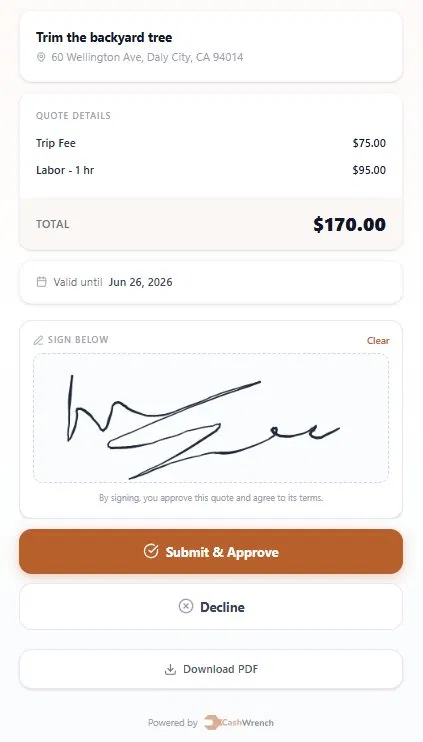
The customer signing screen, the approval statement appears directly above the signature, so consent and signature are captured together at the moment of approval
Requirement 3: Association of signature with the record
A valid eSignature must be attached to, or logically associated with, the specific electronic record being signed. A signature that floats free of the underlying document, or could theoretically be applied to a different document, does not meet this requirement.
This is why a general "I agree to everything" checkbox during account creation is not sufficient to sign a specific contract. The signature must be associated with the specific record at the time of signing.
UETA Section 2(8) defines an electronic signature as "an electronic sound, symbol, or process attached to or logically associated with a record and executed or adopted by a person with the intent to sign the record." The ESIGN Act carries the same standard.
The customer signs on a quote-specific page identified by a unique quote token. The signature image is stored directly against that specific quote record, not against the customer's account or against a generic approval. The signed quote record contains the quote ID, all line items, the total, the validity date, and the signature image together in one retrievable record.
Quote ID · customer name · all line items and total · validity date · signature image (PNG) · signed_at timestamp · customer IP address. These fields are written together as a single atomic record at the moment of signing. The signature cannot be separated from the quote it approves.
Requirement 4: Record retention and retrievability
Both ESIGN and UETA require that electronic records be capable of being retained and accurately reproduced for later reference. A signature that disappears after the session ends, or that can't be retrieved and verified later, does not meet the legal standard.
For a contractor, this is the practical requirement that makes eSignature actually useful. If a dispute arises six months after a job, you need to be able to produce the signed quote, not remember that the customer signed something once.
ESIGN Act Section 101(d) requires that electronic records be capable of retention by the recipient of the record. UETA Section 12 requires that electronic records be retained in a form that accurately reflects the information set forth at the time of agreement and that is accessible for later reference.
Signed quotes are stored indefinitely on the job record in your CashWrench dashboard. The signed quote is accessible at any time, downloadable as a PDF that includes the signature image and metadata, and is not subject to automatic deletion. The contractor can retrieve and reproduce the signed record at any point after signing.
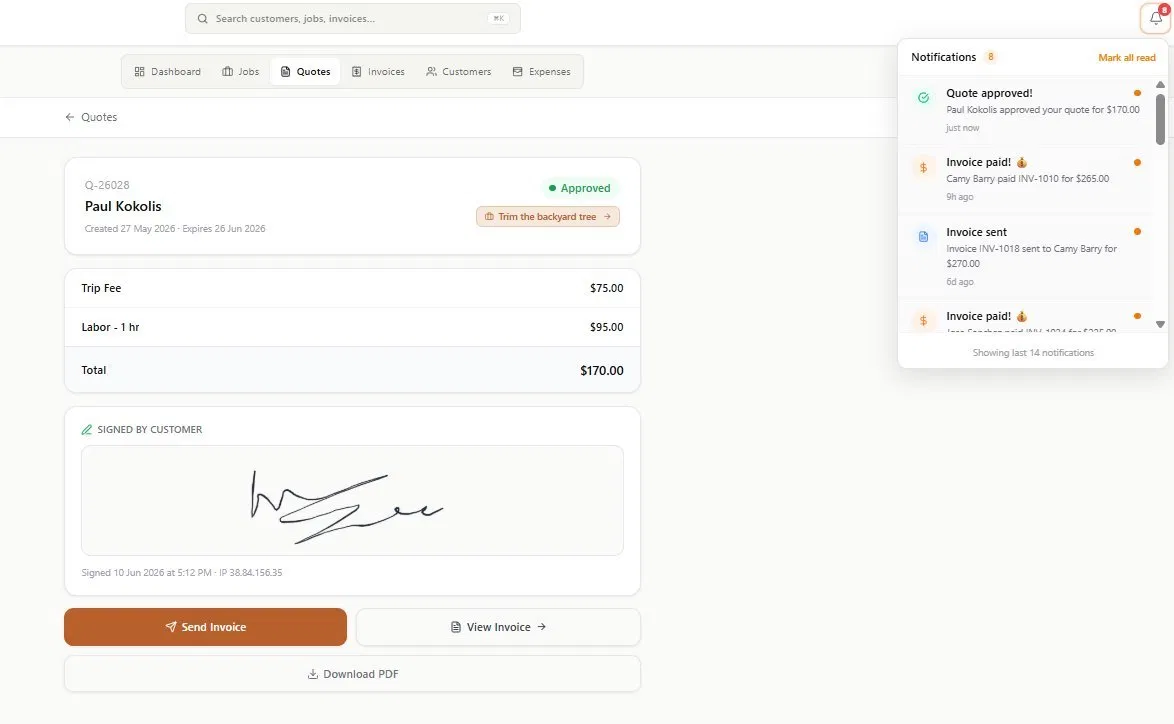
The signed quote record in your dashboard, the "Approved" badge, the stored signature image, the signed timestamp, and the customer's IP address are all retained on the job record and downloadable as a PDF
The law doesn't require a wet signature. It requires intent, consent, association, and retention. CashWrench captures all four, automatically, on every quote.
The audit trail CashWrench captures at signing
Beyond meeting the four core legal requirements, CashWrench captures additional metadata at the moment of signing that significantly strengthens the evidentiary value of the signature if it is ever challenged.
| Data point | What it captures | Why it matters |
|---|---|---|
| Signature image | PNG of the drawn signature from the canvas | Visual evidence of the signing act; stored with the quote record |
| signed_at timestamp | Date and time of submission in UTC | Establishes when the approval occurred; links to the quote validity window |
| Customer IP address | IP of the device that submitted the signature | Helps attribute the signature to the customer's device if challenged |
| Quote token | Unique identifier of the specific quote signed | Links the signature to exactly one quote record, cannot be reused |
| Approval statement | Text shown to customer before signing | Documents the consent language the customer saw at the time of signing |
None of these, except the signature image itself, are strictly required by ESIGN or UETA. But they collectively create an audit trail that makes the signature substantially harder to challenge and substantially easier to enforce if payment is disputed.
Compliance summary
Here's how CashWrench maps to each core ESIGN and UETA requirement:
| Requirement | Met? | How |
|---|---|---|
| Intent to sign | ✓ | Customer draws signature on canvas, a deliberate physical act |
| Consent to transact electronically | ✓ | Approval statement read and accepted before the signature is submitted |
| Association with the record | ✓ | Signature stored against quote-specific token; cannot be reused or detached |
| Retention and retrievability | ✓ | Signed quote stored indefinitely; downloadable as a PDF at any time |
| Audit trail (best practice) | ✓ + extras | Timestamp, IP address, quote token, and approval statement all captured |
Every quote sent through CashWrench includes a compliant eSignature link. Your customer signs on their phone. The signed record, with signature image, timestamp, IP address, and quote details, is stored on the job record and downloadable as a PDF any time.
Included in the Starter plan at $19/month. No add-on required. See how eSignature works →
Frequently asked questions
What is the ESIGN Act?
What is UETA?
Are eSignatures on contractor quotes legally binding in the US?
Does CashWrench meet ESIGN and UETA requirements?
Is the IP address and timestamp required for an eSignature to be valid?
What types of contracts cannot use eSignatures under ESIGN and UETA?
What is CashWrench?
Legally binding signatures on every quote. Two months free.
Send a quote via SMS. Customer signs on their phone. The signed record is stored automatically, ESIGN and UETA compliant from day one. Two months free, no credit card, cancel anytime.